
This text is translation of the section “Analysis of research trends based on the special issues of the conferences organized by the International Society for Salt Lake Research” from the paper Egorov A. N., Yaskelyaynen D. D., Zadereev E. S. Current challenges in the study of salt lakes. Transactions of the Karelian Research Centre RAS. 2025. No. 6. P. 5–16. doi: 10.17076/lim1946 http://journals.krc.karelia.ru/index.php/limnology/article/view/1946
Founded in 2001, the International Society for Salt Lake Research (http://isslr.org/) brings together several hundred scientists and practitioners interested in the study, use, and conservation of salt lakes. Although the society was founded in 2001, international conferences on salt lakes have been held every three years since 1979. A total of fifteen such conferences have been held from 1979 to the present (2024 Turkey, 2021 Spain (online), 2017 Russia, 2014 China, 2011 Argentina, 2008 USA, 2005 Australia, 2002 Russia, 1999 USA, 1994 China, 1991 Bolivia, 1988 Spain, 1985 Kenya, 1982 Canada, 1979 Australia). Detailed information on the conferences and links to published special issues of peer-reviewed journals with selected papers presenting the results of saline lake research are available on the society’s website (http://isslr.org/conferences/). Of course, these conferences do not bring together all the world’s researchers conducting work on salt lakes. However, it can be assumed that the information presented at the conferences gives an idea of global scientific activity in this area of research.
An analysis of the dynamics of affiliations by country among authors of papers in special journal issues following these conferences (Fig. 1) revealed that over 90% of affiliations in the 271 papers published in the special issues belong to 10 countries (USA – 29%, Australia – 19%, Russia – 13%, China – 9%, Canada – 7%, Mexico – 4%, Spain – 4%, Israel – 4%, Germany – 1%, India – 1%). Moreover, the first five countries account for almost 78% of all affiliations. The time dynamics of the share of affiliations by country of authors of papers in special issues of these conferences demonstrates a change in the leaders. In the early years, authors of papers were dominated by researchers from the United States, Australia (it is worth noting that the renowned Australian limnologist Bill Williams (http://isslr.org/about/bill-williams-award/) was the ideologist and founder of the society), and Canada (up to 90% of affiliations in some years). In recent years (2014-2021), researchers from China and Russia have taken the leading roles in terms of the number of affiliations in special issues of journals. The period from 1994 to 2008 was characterized by the greatest diversity, when other countries accounted for approximately 50% of affiliations.
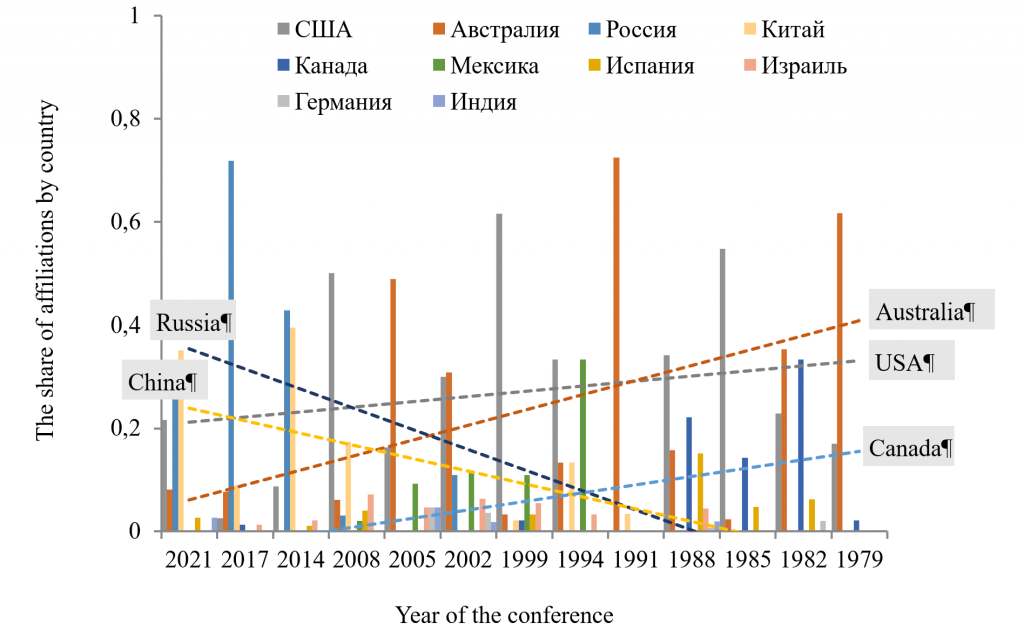
Fig. 1. Dynamics of the share of affiliations by country (10 most frequent countries) of authors of papers in special issues of journals following the International Conferences on Salt Lake Research. Linear trend are given for the 5 most frequent countries (USA, Australia, Russia, China, Canada).
As noted above, the special issues of this conference do not accurately reflect the current distribution of scientific activity worldwide in saline lake research. However, they characterize an indicative trend, in particular the increasing role of the Chinese scientific sector, which is quite universal for other fields of science. A content analysis of the paper titles in these special issues (Table 1) revealed that 1,106 unique words were used in the titles of the 271 published papers. The average number of unique words per title increased over time (from 4 words in papers published between 1979 and 1988 to almost 6 words in papers published between 2008 and 2021), which may indicate increasing research complexity. All unique words in paper titles belong to 4 categories: “lake,” “salinity,” “geography,” and “ecology.” The frequency of use of words from different categories remains virtually constant over time: “geographical” words, characterizing the location of the object of study (lake), are most often used in titles. The predominance of words directly related to the description of the lake suggests that the papers published in these special issues are most often descriptive, faunistic, or regional in nature.
Table 1. Lists, total use (N) and frequency of the use of unique words by category (C) (“lake” (l), “salinity” (s), “geography” (g), “ecology” (e)) in the titles of papers in special issues of journals of International Conferences on Salt Lake Research.
|
List of words (N, C) |
List of words (N, C) |
List of words (N, C) |
List of words (N, C) |
|
Time period |
Time period |
Time period |
Time period |
The frequency (%) of the use of unique words of different categories (l/s/g/e)
| 28 (e) | 17 | 26 | 26 |
| 34 (g) | 39 | 27 | 37 |
| 17 (s) | 28 | 21 | 22 |
| 17 (l) | 16 | 17 | 21 |
Total number of paper titles
| 95 | 76 | 100 | 271 |
Number of unique words per title
| 4.0 | 5.7 | 5.9 | 4.1 |