
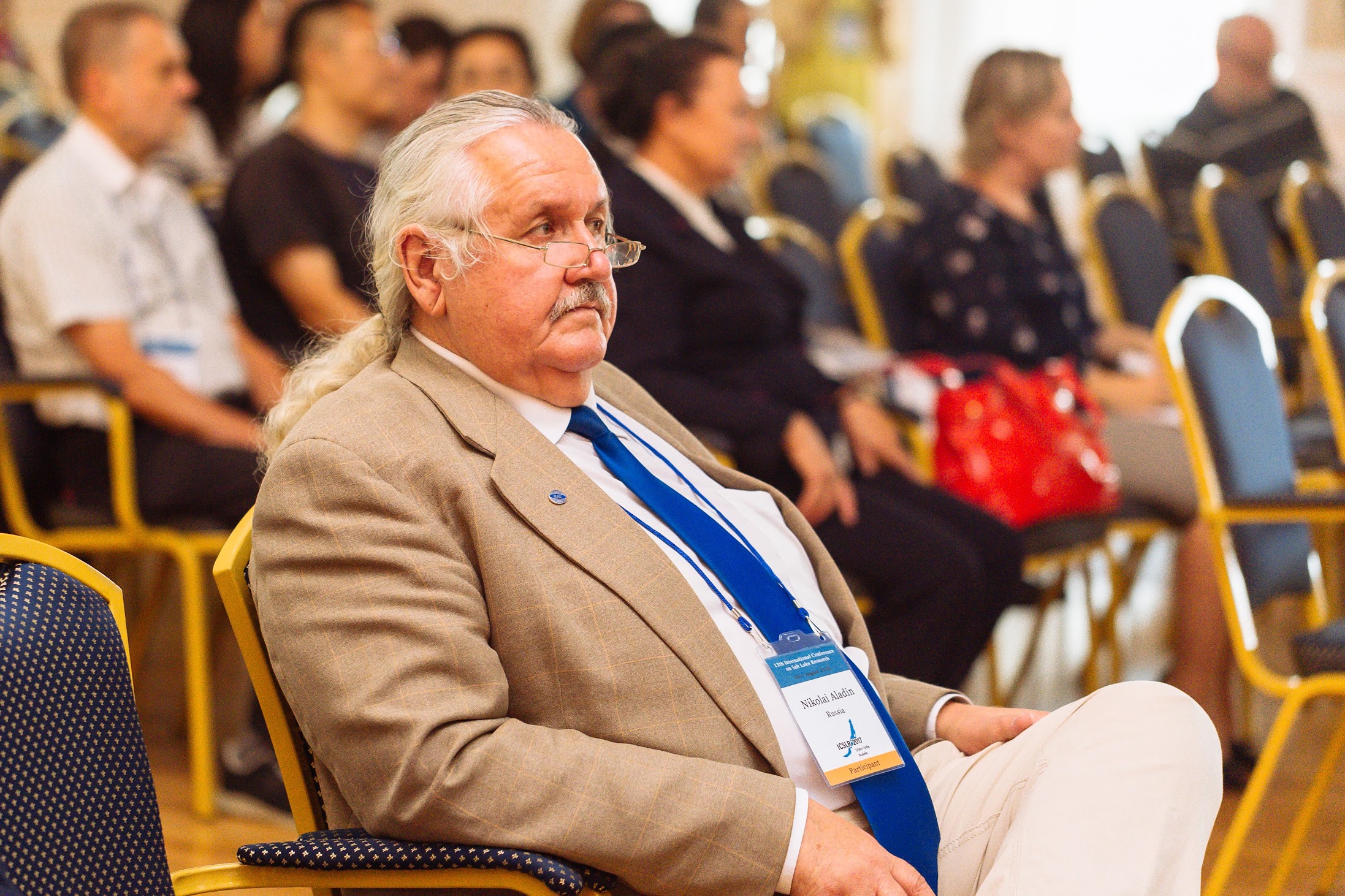
The International Society for Salt Lake Research (ISSLR) mourns the passing, on 15 July 2026 after a long illness, of Professor Nikolai V. Aladin (1954–2026), Chief Researcher and Head of the Brackish-Water Hydrobiology Group at the Zoological Institute of the Russian Academy of Sciences, a towering figure in saline lake science and a cherished member of our global community. Nikolai was not merely a researcher of salt lakes; he was their steadfast defender, and nowhere was this more evident than in his lifelong devotion to the Aral Sea.
For the ISSLR, Nikolai represented the best of what our society stands for: rigorous science placed in the service of conservation. His contributions to the understanding of saline lake ecosystems were foundational. Building on Khlebovich’s concept of critical salinity and Kinne’s concept of the horohalinicum, he put forward his own concept of the relativity and multiplicity of barrier salinity zones to explain how life persists and adapts across the chemical gradients of inland waters. His work on the ecology and osmoregulation of crustaceans, including Ostracoda and Branchiopoda, provided a physiological basis for understanding how communities respond to changing salinity, a theme that would define his career. He authored more than 250 scientific publications and took part in more than 100 field trips and expeditions.
Yet Nikolai understood that data alone could not save a lake. He was a gifted translator, turning the language of physiology and paleolimnology into actionable policy. His scientific authority helped demonstrate that the northern part of the Aral Sea could still be rescued. The plan for the rehabilitation of the Small Aral Sea that he proposed together with his colleagues in the laboratory, including the construction of the Kokaral Dam, has returned the salinity of the Small Aral practically to its original values, restored its biodiversity and allowed its fisheries to return. This stands as a testament to his persistence and vision. He showed that saline lakes, even those on the brink of collapse, are not beyond hope.
His service to the ISSLR and the broader saline lake community was extensive. He served on the editorial board of the International Journal of Salt Lake Research, from 1991 to 2001, helping to shape the field during a critical period. He was co-director of the International Consortium for Salt Lake Research from 1989 to 1993, an essential precursor to the formation of our society, and a member of the Board of Directors of the ISSLR for several years (2009-2014). Nikolai was also a familiar and beloved presence at ISSLR conferences, where he shared not only his latest findings but also his deep emotional connection to the Aral, often through film and personal narrative, reminding us that science is, at its heart, a human endeavor.
He was a bridge-builder across disciplines and borders, meeting with the leaders of Central Asian nations to advocate for the Aral’s survival. His work was recognized in 2008 with the E.N. Pavlovsky Prize of the Russian Academy of Sciences, shared with V.V. Khlebovich, but his true legacy lives in the water that has returned to the Small Aral and in the researchers he mentored, including five PhD students who defended their dissertations under his supervision.
The ISSLR extends its deepest condolences to his family, to his colleagues at the Zoological Institute of the Russian Academy of Sciences, and to all who had the privilege of knowing him. Nikolai Aladin taught us that a saline lake is not a wasteland but a living system worthy of our intellect and our compassion. We will honor his memory by continuing the work he began: to study, to protect, and to restore the world’s salt lakes.